


-22x22.png)

Cart
Your shopping cart is empty!
It's never too late to make things right :)

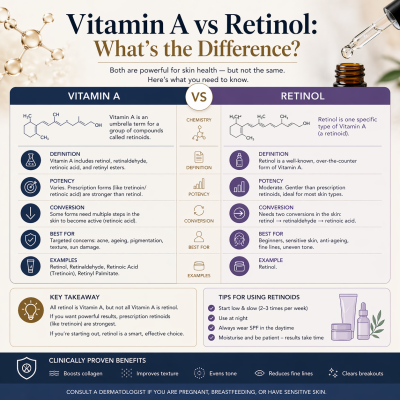
Retinol is a form of Vitamin A. That's the core answer to the vitamin A vs retinol question. Vitamin A is the umbrella term for a family of related compounds; retinol is one specific member of that family, and the one most commonly found in over-the-counter skincare products.
Understanding the distinction matters more than most skincare guides admit. The reason retinol has a reputation for causing irritation, redness, and peeling while professional Vitamin A skincare produces results without those side effects is not magic. It's formulation science.
You've probably seen both terms used interchangeably and felt confused about what you actually need. Most articles on this topic overcomplicate it or use it as a vehicle for selling a specific product. This guide explains the science clearly, covers the full Vitamin A family, and tells you what to look for if you're starting or improving your Vitamin A skincare routine in the UK.
Key Takeaways
- Retinol is one form of Vitamin A; the Vitamin A family includes retinyl esters, retinol, retinaldehyde, and retinoic acid, from mildest to strongest
- All forms of Vitamin A ultimately convert to retinoic acid in the skin to produce their anti-ageing and renewing effects
- High-street retinol products cause irritation because they introduce an active form of Vitamin A too quickly; professional Vitamin A systems like Environ's Step-Up approach start milder and build gradually
- UV exposure depletes Vitamin A in the skin daily; this depletion is one of the main drivers of visible skin ageing
- Most women new to Vitamin A skincare in the UK should start with a retinyl ester-based product (such as Environ AVST 1) rather than a retinol product
Vitamin A is a fat-soluble vitamin that plays a fundamental role in skin health. The vitamin A skincare benefits that researchers have documented include regulated cell turnover, supported collagen production, maintained barrier function, and accelerated repair of UV damage. Without adequate Vitamin A, skin becomes thinner, drier, less resilient, and more prone to the visible signs of ageing.
The problem is that the skin's Vitamin A supply is under constant attack. UV radiation destroys Vitamin A in the skin every time you're exposed to sunlight. Research suggests that a single day of significant sun exposure can deplete a meaningful proportion of the skin's Vitamin A reserves. The British Skin Foundation notes that topical retinoids are among the most evidence-based interventions for UV-related skin damage. Over years and decades, this cumulative depletion accelerates ageing far beyond what would occur naturally. This is why sun protection matters as much as it does, and why replenishing Vitamin A through skincare is one of the most evidence-based approaches to anti-ageing available.
The concept of restoring Vitamin A to depleted skin was developed by Dr Des Fernandes, the plastic surgeon who founded Environ, after studying the skin of patients in South Africa. He observed that high UV exposure correlated directly with accelerated skin ageing, and that the mechanism was largely Vitamin A depletion. His work led to the development of the Vitamin A-based skincare system that Environ is built on. You can read more about this approach at the official Environ skincare website.
Retinol is one specific form of Vitamin A. It's the one you'll see most often in high-street and online skincare because it can be included in cosmetic products at concentrations that have a meaningful effect on the skin, without being a prescription drug.
To understand where retinol sits, it helps to know the full Vitamin A hierarchy:
| Form | Strength | Availability | Notes |
|---|---|---|---|
| Retinyl esters (retinyl acetate, retinyl palmitate) | Mildest | Over-the-counter | Converted to retinol in the skin; well tolerated; used in Environ's lower AVST levels |
| Retinol | Moderate | Over-the-counter | Converts to retinaldehyde then retinoic acid; the most common active form in cosmetics |
| Retinaldehyde | Strong | Over-the-counter (limited) | One step from retinoic acid; more potent, more potential for irritation |
| Retinoic acid (tretinoin) | Strongest | Prescription only | The active form; no conversion required; used in medical treatment of acne and ageing |
Every form in this hierarchy eventually becomes retinoic acid once it is absorbed into the skin. Retinoic acid is the compound that actually binds to the skin's receptors and produces the changes in cell behaviour that lead to improved collagen production, faster cell renewal, and the visible anti-ageing effects people associate with Vitamin A skincare.
The milder forms take longer to convert and produce a gentler effect. That is not a weakness. It is precisely what makes them suitable for consistent long-term use without the irritation that stronger forms cause.
When people ask about vitamin A vs retinol, they are usually asking one of two questions: which is better, or which is safer. The honest answer is that neither is universally better. The right choice depends on where your skin is starting from and how it is introduced.
Because all Vitamin A forms convert to retinoic acid before they produce their effect, the end result of a retinyl ester-based routine and a retinol-based routine is the same: retinoic acid acting on your skin cells. The difference is how fast you get there and how much your skin has to cope with along the way.
A high-concentration retinol product introduces a form of Vitamin A that is relatively close to retinoic acid. The skin converts it quickly. The effect is fast. But skin that hasn't been using Vitamin A regularly can react with dryness, flaking, and redness because the conversion rate outpaces the skin's ability to adapt. This is what most people experience when they start a retinol product too aggressively.
A retinyl ester-based product introduces the mildest form. The conversion is slower. The skin adapts at a manageable pace. Over time, the same transformation occurs in the skin structure, but without the reaction phase that makes many people abandon Vitamin A skincare before it can work.
When Diane, a 49-year-old from Oxford, first came to Skincare Online in autumn 2025, she had already tried retinol twice. The first time, she bought a 0.3% retinol serum from a well-known high-street brand. By week three, her skin was red, flaky, and tight. She stopped. Six months later, she tried a 0.5% retinol serum recommended by a beauty editor. Same result, worse this time. She concluded that her skin "couldn't tolerate retinol." We explained that her skin didn't have a retinol problem. It had a concentration and pacing problem. She started on Environ AVST 1, which uses retinyl acetate. No reaction. By month four, she described her skin as "completely different." She is now on AVST 3.
The insight behind Environ's Step-Up System is directly related to the vitamin A vs retinol question. Rather than starting at a concentration of Vitamin A that the skin must struggle to tolerate, the system starts at the mildest retinyl ester concentration and increases it gradually. By the time the skin is receiving a meaningful concentration of Vitamin A, it has already adapted and built its capacity to use that Vitamin A effectively.
This is not a workaround. It is the scientifically correct way to introduce Vitamin A to skin that has been depleted of it, which is most skin by the time women reach their 30s and 40s.
Interested in starting the Environ Vitamin A system? Browse our full Environ skincare range, including the AVST moisturisers, or read our detailed Environ review for more on what to expect.
In the vitamin A vs retinol debate, retinol is not inherently problematic. The issues associated with it, the peeling, the redness, the so-called "retinol uglies", are largely a product of how it has been marketed and used, not what it fundamentally is.
The skincare industry discovered that consumers respond to potency signals. A 1% retinol product feels more serious than a 0.1% one. Marketing language around retinol has consistently pushed towards higher concentrations and faster results. The result is that many women start at concentrations that are too high for skin that has never used Vitamin A, experience the predictable reaction, and conclude that Vitamin A skincare is not for them.
The reality is that the reaction is not a sign of effectiveness. It's a sign of introduction speed mismatch. Skin that reacts badly to retinol is not rejecting the ingredient. It's telling you it needed to start slower.
Kate, a 44-year-old aesthetician from Cardiff, described this to us clearly at a trade event in early 2026: "The number of clients who come to me saying they can't use retinol is always the same story. They started at too high a concentration, had a reaction, stopped. If they'd started with a retinyl ester and built up, they'd have had none of that. The ingredient isn't the problem. The approach is."
Environ's skincare philosophy is built almost entirely on Vitamin A science. Dr Des Fernandes' original research into UV-driven Vitamin A depletion and its role in skin ageing led directly to the AVST system. Every AVST moisturiser from level 1 to level 5 contains a progressively higher concentration of Vitamin A, beginning with retinyl acetate and introducing retinol at higher levels as the skin adapts.
The full AVST journey for most users looks like this:
What Environ's system achieves over time is not just surface improvement. It rebuilds the skin's structural integrity from the inside out, supporting the dermis as well as the epidermis. This is why the results with Environ go beyond what surface-level retinol products achieve, even at high concentrations.
If you'd like to start your Vitamin A skincare journey with the right foundation, our team is available via WhatsApp or email to recommend the correct Environ products for your skin. Ask our skincare experts for guidance before your first order.
Whether you're searching for retinol for beginners UK advice or are already familiar with the basics, the principles for beginning safely are the same regardless of which form you choose.
Start low and slow. The most common mistake is starting at too high a concentration. If you're new to Vitamin A skincare, begin with the mildest available option. For professional Vitamin A, that is Environ AVST 1. For high-street retinol, that is 0.025% to 0.05%.
Introduce gradually. In the first two to four weeks, use your Vitamin A product every other evening rather than nightly. Let your skin adjust. If there's no reaction after four weeks, move to nightly use.
Moisturise generously. In the adaptation phase, the skin may feel drier than usual. Applying a rich, nourishing moisturiser after your Vitamin A product helps manage this. Our professional moisturisers include several suitable for pairing with Vitamin A skincare.
Always use SPF in the morning. Vitamin A makes the skin more sensitive to UV during the early adaptation phase, and UV exposure depletes the Vitamin A you are working to restore. SPF is not optional in a Vitamin A routine. Browse our sun care range for options that sit comfortably on most skin types.
Don't combine with other actives initially. AHAs, BHAs, and high-strength Vitamin C products can all increase sensitivity when combined with Vitamin A in the early stages. Introduce them one at a time after the adaptation phase is complete. You can browse our serums and boosters to see which actives are worth layering in once your skin has adjusted.
What to expect:
- Weeks 1-4: Possible mild dryness or tightness. This is the adaptation response. It passes.
- Weeks 4-12: Improved skin texture, more even tone, clearer radiance.
- Months 3-6: Visible improvement in fine lines, skin density, and overall skin quality.
- Beyond 6 months: Continued structural improvement. This is where the real long-term benefit of Vitamin A
skincare becomes clear.
Is retinol the same as Vitamin A?
Retinol is one form of Vitamin A. The Vitamin A family includes retinyl esters, retinol, retinaldehyde, and
retinoic acid. All forms convert to retinoic acid in the skin to produce their effects. Retinol is the most
commonly used form in over-the-counter cosmetics.
Which is better for anti-ageing: Vitamin A or retinol?
They work the same way. The difference is in how the active is delivered and at what pace. Professional
Vitamin A systems like Environ's AVST range use retinyl esters at the entry level, which are gentler and
better suited to long-term consistent use. High-street retinol products often introduce Vitamin A faster
than skin can comfortably adapt to, leading to the irritation that puts many women off.
Can I use retinol if my skin is sensitive?
Sensitive skin can use Vitamin A skincare, but it must start at the mildest form and lowest concentration
available. Retinyl esters (as found in Environ AVST 1) are the most appropriate starting point for sensitive
skin. Consult a skin therapist before starting if your sensitivity is clinically diagnosed.
How long does it take for Vitamin A skincare to work?
Initial improvements in texture and radiance are usually visible within six to twelve weeks of consistent
use. Deeper structural improvements, particularly around fine lines and skin density, typically take three
to six months. The results are cumulative; the longer and more consistently you use Vitamin A, the more
significant the improvement.
Do I need a prescription for Vitamin A skincare?
No, for cosmetic-grade Vitamin A products. Retinoic acid (tretinoin) is prescription-only in the UK. Retinyl
esters, retinol, and retinaldehyde are all available in over-the-counter skincare. Professional brands like
Environ are available through authorised stockists without a prescription.
The vitamin A vs retinol question, once understood properly, answers itself. They are members of the same family, working through the same mechanism. The important questions are not which one you choose but where you start in terms of concentration, how quickly you build up, and whether you support the process correctly.
For most women in the UK approaching Vitamin A skincare for the first time, starting with a professional retinyl ester-based system is the most reliable path to results without unnecessary irritation. The science is clear. The results, with consistent long-term use, are among the most significant available from any category of skincare ingredient.
Browse our Environ skincare products to explore the full AVST range and supporting products. If you're unsure where to start, our professional moisturisers page includes everything you'll need alongside your Vitamin A routine. Or contact our skincare team via WhatsApp or email for a personalised recommendation. Professional skincare, delivered to your door.